
Dear friends of alpine and high altitude medicine, dear colleagues,
England and the British have a long mountaineering tradition, although the island and its elevations cannot measure up to our alpine peaks in terms of altitude. In England, a mountain is a mountain if it measures higher than 2,000 feet. Converted, that is 609.6 meters. The highest mountain in the United Kingdom is the 1,345 m high Ben Nevis in the Scottish Highlands, which can, however, offer very alpine conditions.
In May, the World Congress of Mountain and High Altitude Medicine took place in the small town of Hathersage in the English Peak District. The Peak District historically promises much challenging terrain in the area, which once served Robin Hood and his companions as retreats.
The congress produced countless peaks in the sense of highlights, and we report on these in detail in this issue. The summit topic for me was clearly the subject of women in the mountains, which was examined from several facets. Impressive in this context are the achievements of Nepalese female mountaineers, female guides and Sherpas, who are now gaining more attention in the international mountaineering press, and whose path is certainly often very steep and rocky.
Hosts in England were the International Society of Mountain Medicine (ISMM) together with the British Mountain Medicine Society (BMMS); on board were the major alpine organizations UIAA and ICAR MEDCOM. The highlight of the three-day congress was the International Symposium on Accidental Hypothermia, led by Beat Walpoth and Chris Imray. You will find a detailed congress report in this issue.
For some it is relaxation in nature in the enchanted winter world, for others it is an Olympic discipline: read the exciting article on ski touring as a competitive sport.
In this issue we read an article on expeditions to high altitudes with people who have survived a lung transplant. These extraordinary physical achievements and complex physiological relationships show us how unique our body is, and how extremely adaptable we can be at high altitudes. The uniqueness of the will to survive, endurance and extreme physical and mental performance is also shown by the recent story from this season on Mount Everest, which had us all holding our breath at the end of the season – the almost unbelievable survival story of Darwa Sherpa. It also makes us thoughtful and leads us to the topic of ethics in rescue from high altitudes, a position paper recently published by ICAR MEDCOM.
At the beginning of October, the Mountain Clinic of EURAC in Bolzano was officially inaugurated; you will find a portrait of the clinic in this issue.
At this point I would like to thank the ÖGAHM for the wonderful collaboration and I am pleased to invite you in the fall to the anniversary conference of BEXMED. In Garmisch-Partenkirchen we will celebrate our 30th birthday from November 20 to 22 – information on the conference and registration can be found in the issue.
I wish you a beautiful mountain summer,
Yours, Natalie Hölzl
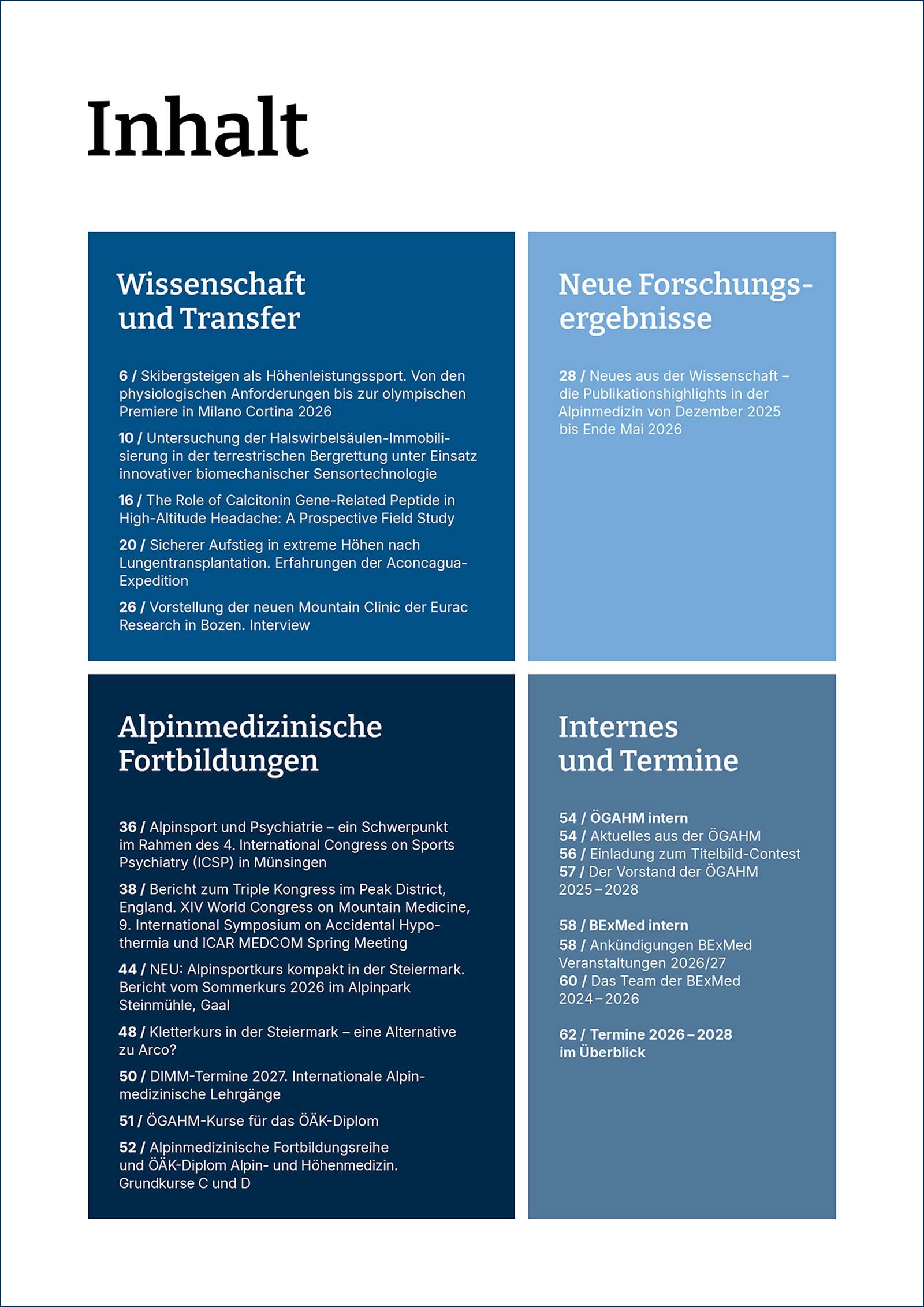
Contents of Newsletter No. 75
Here all interested parties can go to the overview of the Alpine Medicine Newsletters.
And here to the download in the members’ area.